
You recorded it, transcribed it and used the bit you needed. Then never revisited it.
Most people use a transcription tool once per file. The transcript gets read and a few lines get pulled out. Then the file joins a folder nobody opens again. Everything you learned is still in there. Six months on you have forgotten it, because no one has superhuman memory. You just have no way to ask it anything.
You do now.
See how Explore works
01 / Context
It starts with your transcriptions.
Every tape you record or upload is transcribed and lands in your archive. Explore works on top of those transcripts: your whole archive, a project or a single tape is the context it reads, so it only ever draws on what you put there.
- Archive
- Projects
- Tapes
02 / Overview
Your archive, mapped by topic.
Explore surfaces meaning from your transcriptions across different context scopes: your archive, a project or a tape. It suggests the topics that keep coming back, takes the ones you add yourself, and opens the strongest passages behind each. It is incredible for finding connections and the things you missed.
- Suggested topics
- Your own topics
- Archive scope
- Project scope
03 / Insights
The other tapes that matter, while you read.
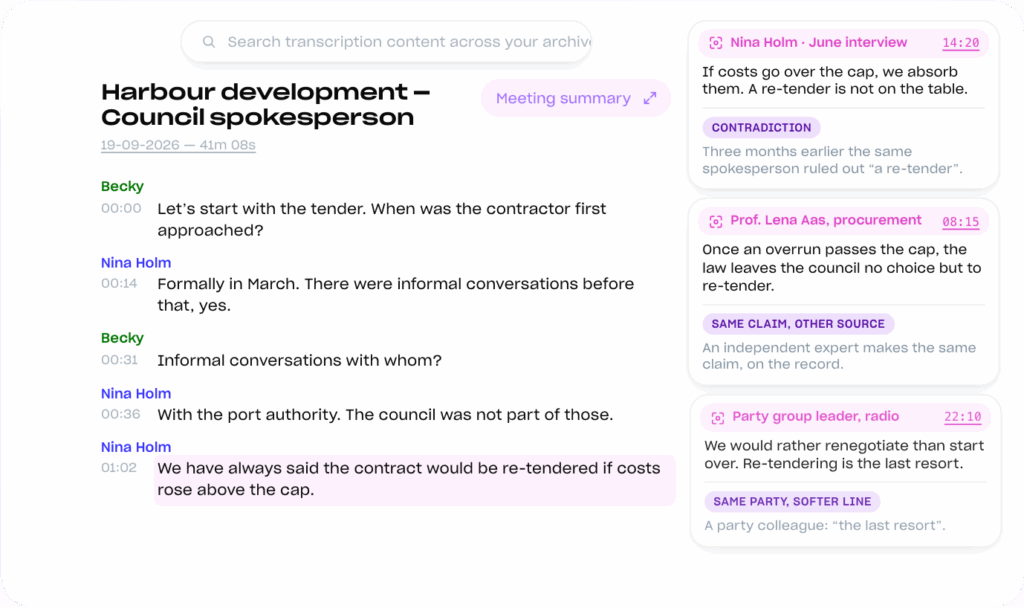
Open a tape and Explore pulls the relevant passages from the rest of your context into the margin, each with its source, its timestamp and one line on why it is there: a contradiction from three months ago, an expert saying the same thing, a colleague putting it differently.
- Contradiction
- Supporting statement
- Nuance
- Source and timestamp
04 / Chat
Ask, and get the source with the answer.
Ask your archive for statements that support or contradict what you just read, the quotes worth using or three headline ideas. Every answer comes with the tape and timestamp attached: the same passages Explore surfaced in the margin a moment ago. Ask it to act, and it will: a project with every tape on a subject, in one message.
- Questions
- Quotes
- Headlines
- Actions
Every tape you add makes the next one worth more
Explore is a context layer over everything you record. Upload a tape and Explore reads it against your whole archive, then hands you what connects: a claim that contradicts something you were told five months ago, a quote that backs it up, a theme that keeps coming back, a detail you noted once and forgot. That tape then joins the archive itself and does the same job for the next one. The loop compounds. The more you put into Good Tape, the more each new recording is worth.
What you recorded yesterday may be the thing that matters in six months, long after you stopped thinking about it. Explore is what remembers it.
Every answer and every insight arrives with the source file and the transcript it came from, so you can open it and check the claim before you use it.
One interview, three stories
- You run the interview. A politician gives you 40 minutes on the fishing quota. It transcribes while you walk back to the office, speaker labels already in place.
- Today, that is one article. It is accurate and it is informative. It is also the piece anyone with the same 40 minutes would file. Nothing in it says anything your readers could not have guessed.
- Explore reads it against everything else you have recorded. An insight surfaces in the sidebar, labeled Contradiction: the same minister told you the opposite five months ago. The quote is there. So is the source file.
-
You take it to chat and push on it.
You What has the minister said about the quota cut across all my interviews?
Explore Two positions. In “Ministry interview, 12 April” she calls the cut “the only responsible thing to do given the stock numbers.” In today’s tape she calls it “an overreach that cost coastal towns their living.” Both source files attached.
You What happened in between?
Explore Two of your recordings sit in that window. A 3 June interview with a fisheries economist dates the stock recovery to May. A 28 August town hall has three coastal mayors asking her to reverse it, on the record. Source files attached.
-
A second insight backs the new angle up, labeled Support.
An economist you interviewed in June made the same point about the timing, in her own words, and you had forgotten the line was in there.
Support
“By May the stock had recovered. Anyone deciding after that was deciding on old numbers.”
Fisheries economist, 3 June
-
Three stories instead of one.
The quota piece you came for. The reversal and what moved it. The town hall that nobody covered. All three are sourced to tapes you already had. And this interview now joins the archive, so it is what surfaces the next time you record something that touches it.
Coming soon
And now imagine you could also get insights from the interviews your colleagues did. Then there might be several more angles, and several more stories.
We have saved tonnes of tedious time, that we are now spending on the more creative side of doing journalism
Lea Korsgaard Co-founder & Editor-in-Chief, Zetland
Turn it on and your whole archive is already searchable
The price, plainly
Launch offer: Explore is included for free in every plan while it is new.
Explore
NEW€0 /monthly during the launch
Base usage is included. After the launch, Explore is €10/month, or €8/month billed yearly.
Try Explore for freeChat
- Chat with a tape, a project or your archive
- Ask follow-ups and challenge any answer
- Get headline ideas, quotes and angles
Insights
- See related passages from your archive as you read
- Spot what earlier tapes contradict or confirm
- Source and timestamp on every insight
Topics and overview
- Surface the topics that run through your recordings
- Add your own topics to the suggested ones
- Work across a single tape, a project or your archive
Works on your existing tapes and every new one. No training on your data, no new subprocessors.
Privacy and Security
Explore lives up to all of Good Tape’s standards on privacy and security, with no new subprocessors.
-
Zero training on your data Your recordings and transcripts are never used to train any model.
We never use your recordings, transcripts, or account content to train our AI models or anyone else's. We use your data for one thing: delivering your own transcription and Explore results.
-
EU hosting All infrastructure runs inside the EU.
We process and store your data only on servers inside the EU. It never leaves. Every subprocessor we use, and where it sits, is listed in our Data Processing Agreement.
-
End-to-end encryption Your data is encrypted in transit and at rest.
We encrypt your files and transcripts in transit with TLS 1.3, and at rest with AES-256. Encrypted from the moment they leave your device.
-
GDPR compliance Built to meet GDPR requirements by design.
We built and run Good Tape to GDPR requirements: your rights as a data subject, and a lawful basis for every kind of processing we do. We collect no data we do not need.
-
ISO 27001 Independently certified information security management.
We hold ISO/IEC 27001:2022 certification, the international standard for information security management. Certified by TNV System Certification Pvt. Ltd. on 30 January 2026, valid through 29 January 2029, with recurring independent audits.
-
Data Processing Agreement (DPA) Signed Data Processing Agreements available for every customer.
Every customer can get a signed Data Processing Agreement. It states in writing how we process your data, how we protect it, and which subprocessors touch it.
-
Service Level Agreement (SLA) A documented SLA with 48-hour support response times.
A documented Service Level Agreement covers the core transcription service. You get a first response within 48 hours on business days, 72 hours at weekends. Critical incidents are resolved within 24 hours of acknowledgment.
Every transcript is private to you by default. Nobody sees it until you share it, and you can revoke a share at any time. Not even a team owner can read your files.
Questions people ask before they start
What does Explore cost?
Nothing while Explore is new. It is included for free in every plan, the free trial as well as Pro and Business, with base usage included. After the launch, Explore is €10 a month, or €8 a month billed yearly. If you need it for a whole organization, talk to us.
Does it work on the files I already have in Good Tape?
Yes, all of them. Switching Explore on indexes everything already in your account, at no extra usage cost, so your first search runs across years of work rather than across an empty library. The older the archive, the more it has to work with.
Can I trust the answers?
Every answer comes back with the source file and the transcript it came from. Open it and check the claim yourself. Nothing is presented without a source.
What happens to my recordings?
They stay on servers inside the EU, encrypted in transit and at rest. They are never used to train any model. A transcript is private to you until you decide to share it, and you can revoke a share at any time. Not even a team owner can see the contents. You can always delete your own files and projects, and when you delete a file it is removed from all our systems, including backups, within 12 hours. If someone leaves a team, we work with each customer to put the right mechanism in place for that.