Summary
- Good Tape for legal provides law firms and judiciaries with a highly secure environment for converting courtroom audio and depositions into text.
- Using legal transcription software for law firms significantly reduces the administrative burden on clerks and attorneys.
- Specialized legal transcription software speech to text technology ensures that every witness testimony and hearing is captured with verbatim precision.
- Chilean Judge Cristián Soto Galdames uses Good Tape to restore focus and natural flow to courtroom proceedings by eliminating manual note taking.
- All files are protected by AES-256 encryption and processed within the EU to remain fully compliant with strict GDPR and judicial standards.
- Good Tape is ISO 271001 certified.

Secure legal transcription software
In the legal profession, every spoken word carries weight. Whether it is a client consultation, a witness deposition, or a formal courtroom hearing, the need for a precise written record is non negotiable. However, the traditional methods of capturing these dialogues are often slow and prone to human error. Legal transcription software has emerged as a vital tool for modern law firms, allowing them to transform hours of spoken information into actionable data in a matter of minutes.
The primary challenge facing legal professionals is the sheer volume of audio data generated by every case. A single hour of deposition can take a full day to transcribe by hand. Too often, valuable insights stay trapped in audio files or buried in fragmented notes. This is not just an inconvenience. It is a risk to the integrity of the case. Using professional software for legal transcription ensures that nothing is missed, helping firms avoid delayed filings and weakened arguments.
What is the best legal transcription software for law firms?
Legal transcription software for law firms must be more than just a speech to text engine. It needs to be a robust, secure, and highly accurate system that understands the complexities of legal terminology and multi speaker environments. Firms are increasingly moving away from manual typing and toward automated solutions that provide near instant results. The shift toward digital transcription for lawyers has allowed teams to focus on strategy and advocacy rather than administrative tasks.
When evaluating legal transcription tools for law firms, security is usually the top priority. Lawyers and judges work with sensitive data and high public accountability, meaning trust is not optional. Good Tape for legal is built on a foundation of privacy. We are ISO certified. We never use your files for AI training and never share your data. With servers based in the EU and full GDPR compliance, your work remains private and protected at all times. This makes it an ideal legal transcript generator for organizations that handle confidential information daily.

Professional features
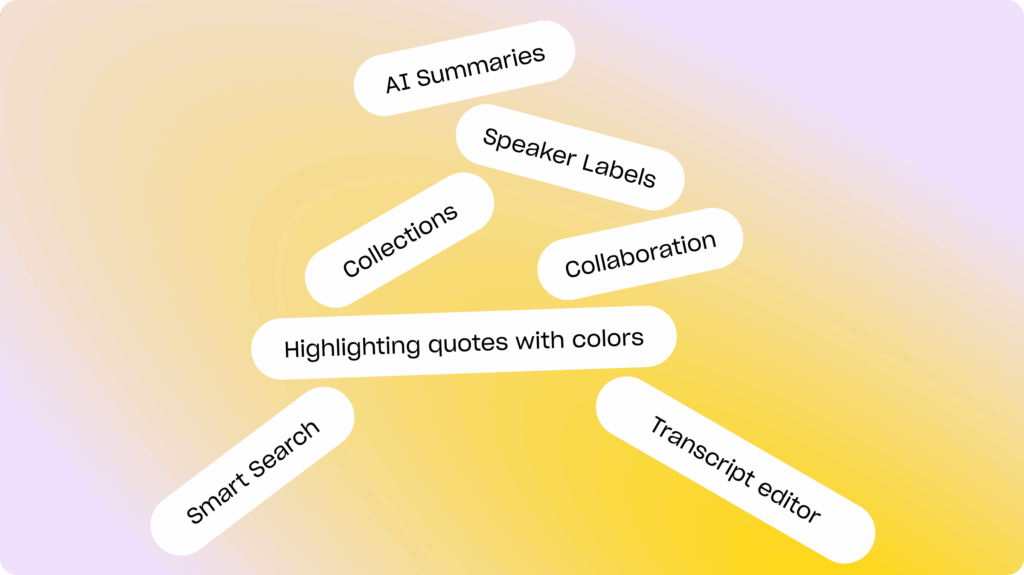
Priority transcription for lighting fast processing and no waiting times
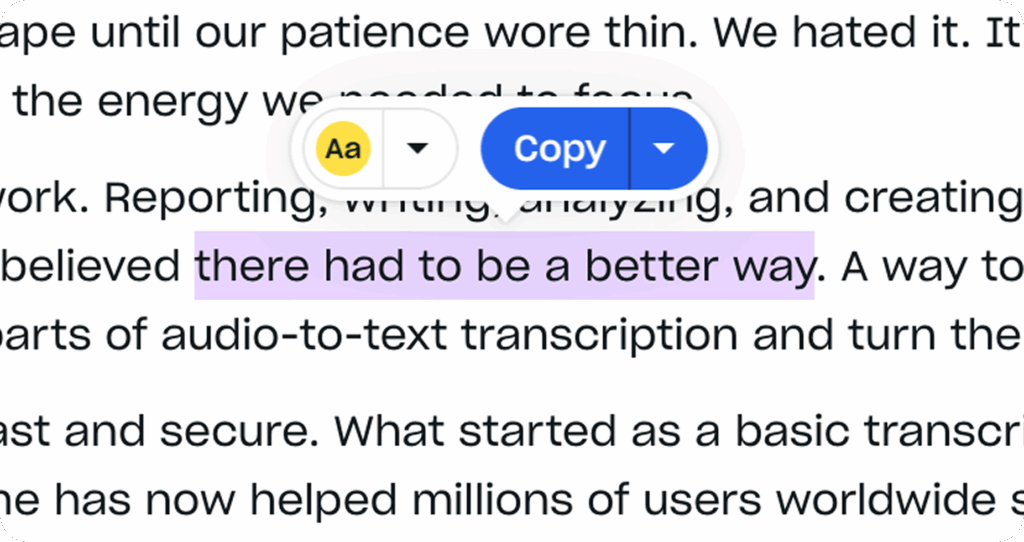
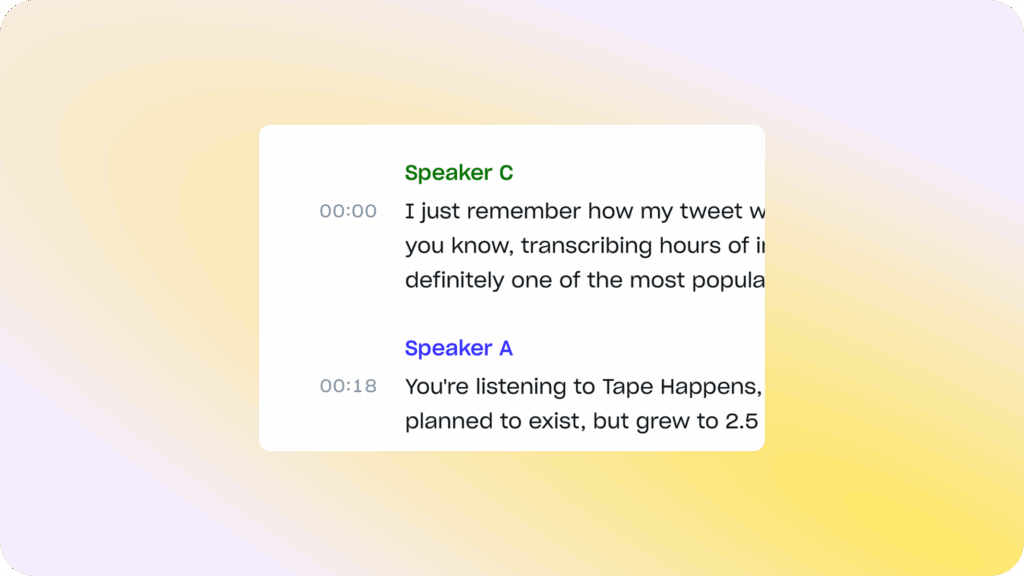
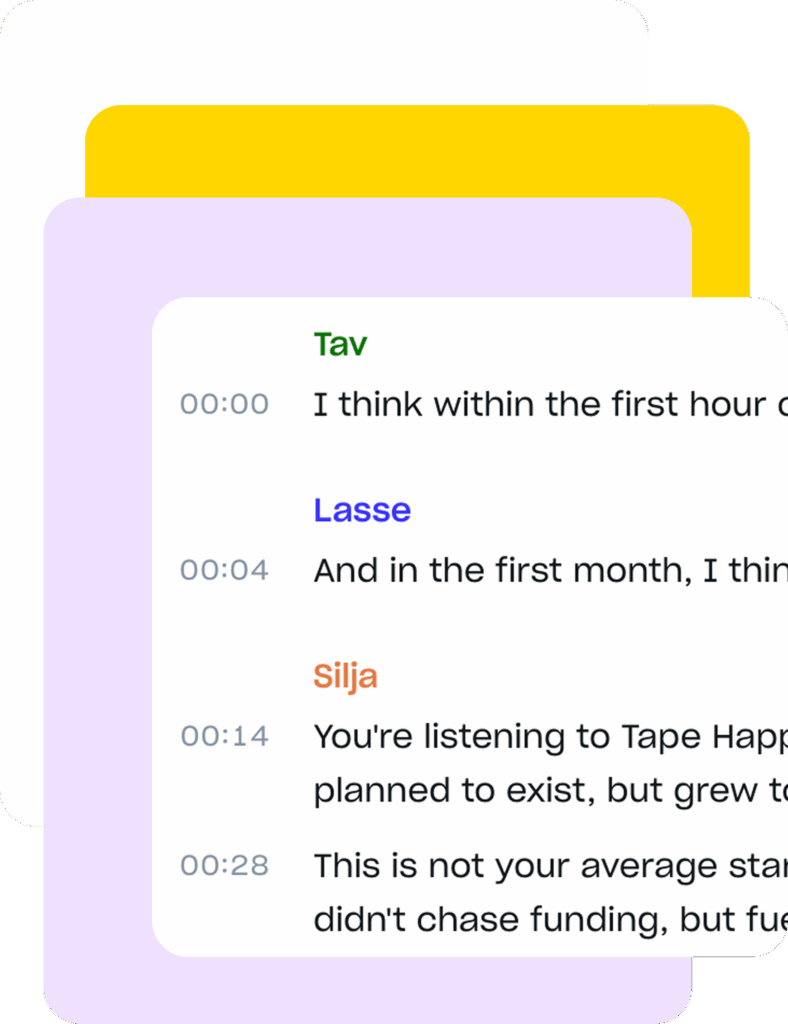
Speaker labels let you know who said what and when
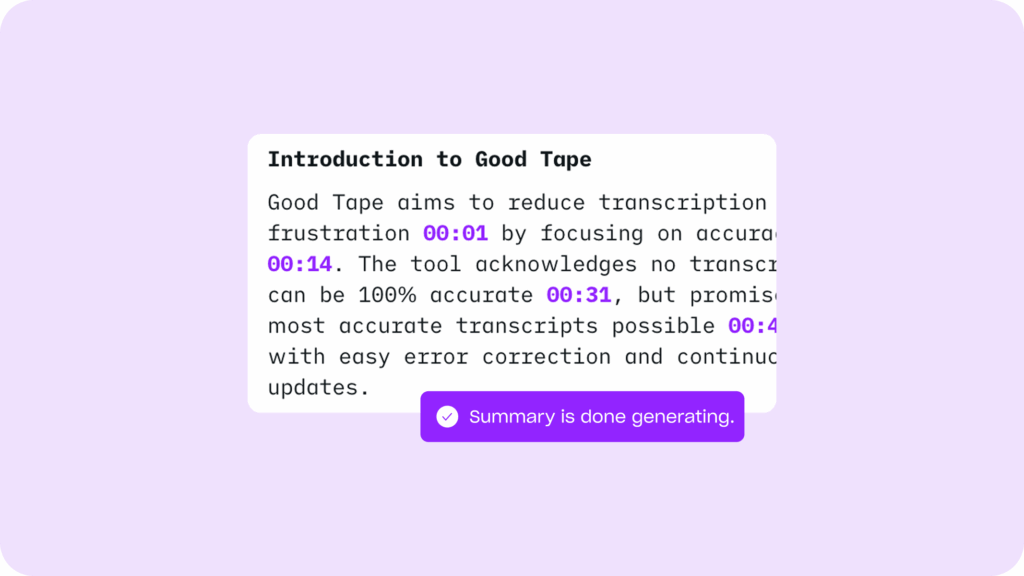
AI Summaries to quickly get insights and information
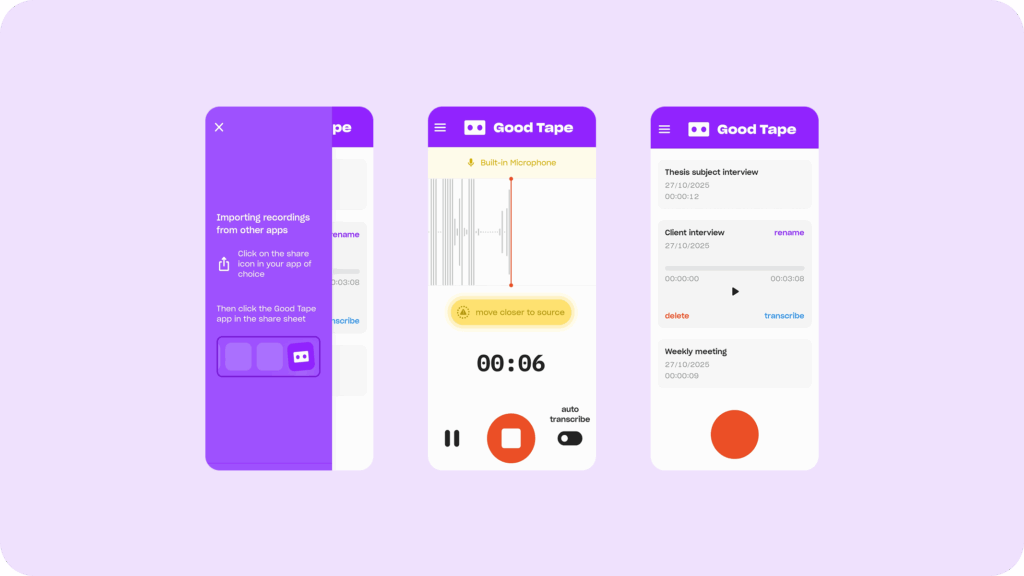
Recording app to streamline workflows (coming soon)
Bulk uploads to save even more time when starting projects
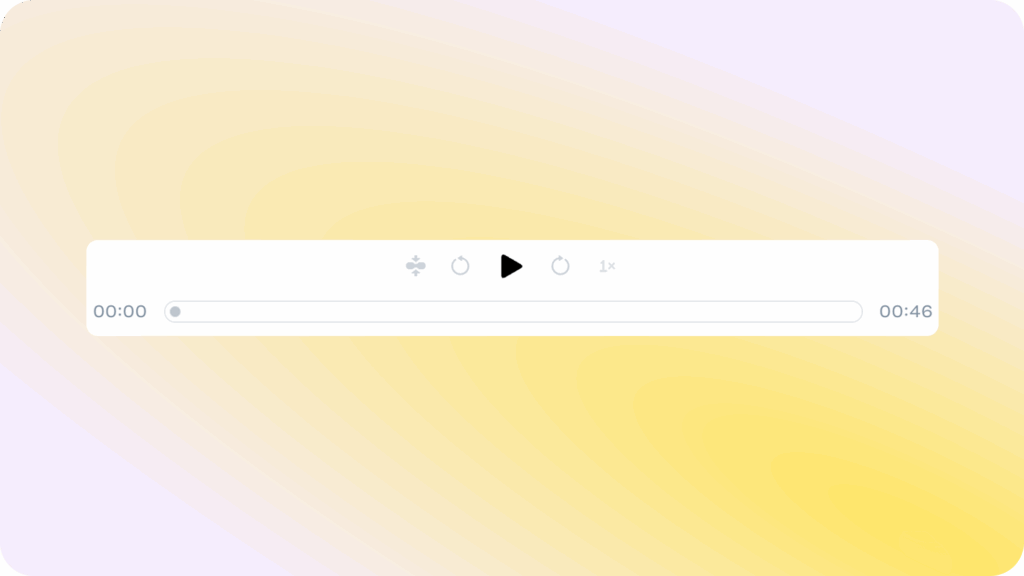
Audio playback so you get clarity with every word spoken
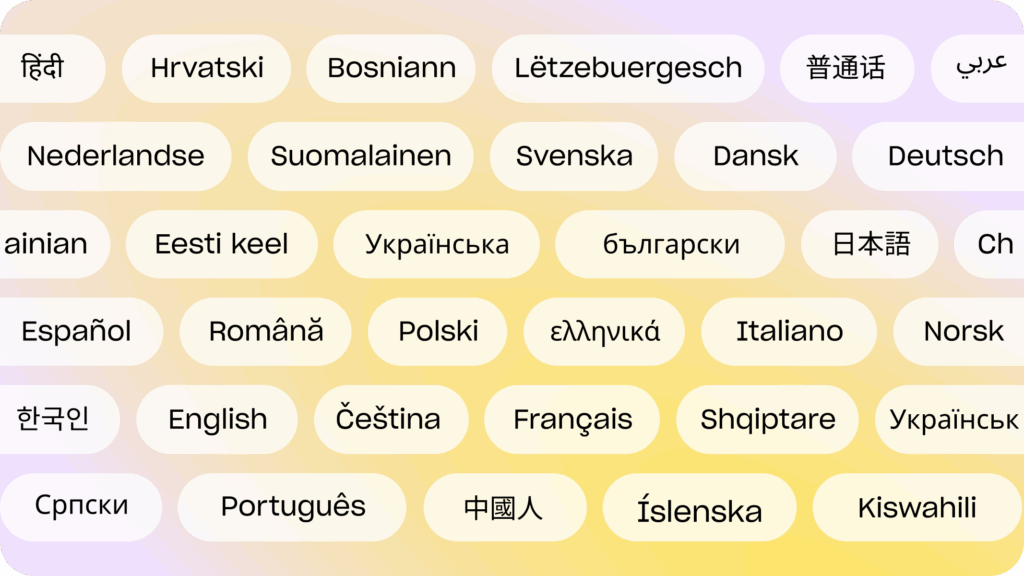
100+ languages so you can work across boarders
Collections that help you organize files and have overview
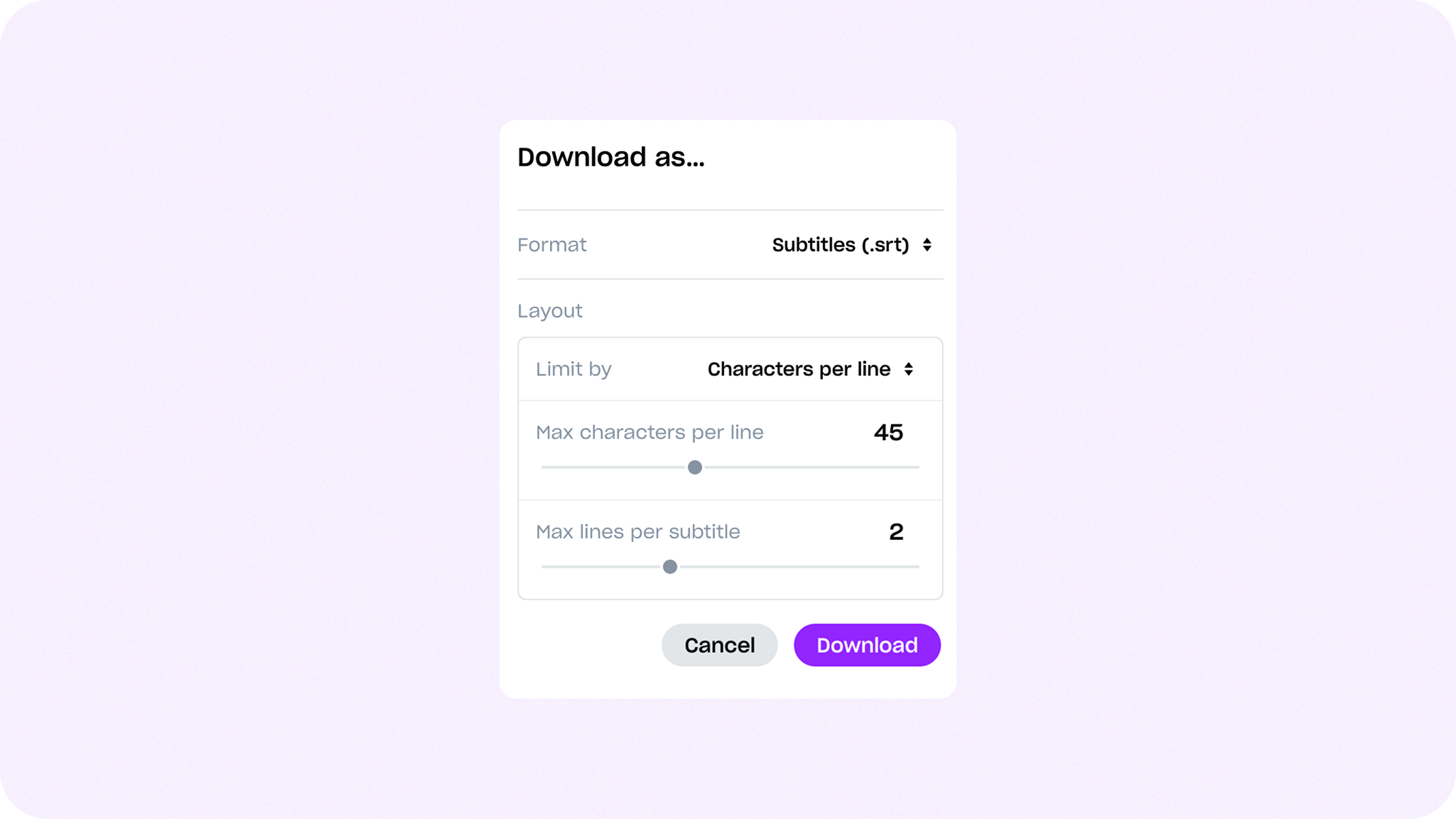
Export subtitles for easy .SRT subtitles to allow for accessibility
Smart search, translation, DPA, priority customer service and more
Legal transcription software you can actually trust
Transform your firms workflow with Good Tape
Case study: Meet Cristian
The challenge
For years, courtroom transcription in Chile was a slow, manual process that drained time and focus from the people who mattered most: the judges and clerks actually running the trials. Every word spoken in court had to be captured by hand or typed live. That meant hours of note-taking, constant interruptions, and countless moments lost to the sound of keyboards instead of human attention.
The process was exhausting. Judges found themselves spending more time trying to document what was said than truly listening to it. The result was inevitable: important details were missed, hearings dragged on, and post-trial summaries became a second full-time job.
Manual transcription wasn’t just tedious, it was risky. A small error could distort meaning, a missed word could alter understanding, and the pressure to keep up often left professionals mentally drained at the end of each day.
We had to ask, ‘What happened?’ because we were too busy typing.
The turning point
When Judge Cristián and his team first heard about Good Tape, they didn’t expect much. Another tool promising to make their lives easier, they’d seen that before. But once they tried it, skepticism turned into quiet astonishment.
It began with something simple: recording a single courtroom session on a laptop. The audio was uploaded, transcribed, and returned as clean, readable text in minutes. Suddenly, the hours once spent typing were gone. Replaced by time to focus, reflect, and deliberate.
Soon, Good Tape was being used for more than just hearings. Judges transcribed witness testimonies for quick review. Clerks created written summaries directly from transcripts. Legal teams used transcripts for cross-referencing and training. What started as an experiment became a shift in how the entire courtroom operated..
Once we saw how easy it was, everyone started using it.
The results
The change was immediate and measurable. Tasks that once took hours were now done before lunch. Transcription no longer required external agencies or manual effort. Everything happened inside the secure, encrypted Good Tape environment, where files remained private and compliant with strict judicial confidentiality standards. Across the court, Good Tape became a quiet revolution.
Fairer outcomes: decisions were based on fully captured, fully reviewable dialogue.
Faster case documentation: hearings that used to take days to transcribe were processed in minutes.
Improved accuracy: automatic speaker labeling and time stamps made reviewing testimony effortless.
Reduced fatigue: judges and clerks could finally focus on what was being said, not on capturing every word.
Better training material: transcripts were reused to educate new clerks and law students.
Transcription stopped being a burden and became a creative tool.
The human impact
What surprised Cristián most wasn’t just the time saved it was the mental clarity it brought back into the room. When people stopped typing and started listening, the courtroom became more human again. There was eye contact. Attention. Presence.
Instead of living through a blur of note-taking, legal professionals could actually engage with the people speaking. It changed the atmosphere completely — less mechanical, more focused, and more empathetic.
For the clerks, it meant relief. For the judges, it meant better decisions. And for the justice system, it meant progress.
Now, we listen better, work faster, and spend more time on what truly matters: justice.
Trusted by professionals and teams








Want to read more?
Check out these related resources



Help center (FAQ)
Is Good Tape legal transcription software approved for use in legal settings?
es. Good Tape is designed for professionals who deal with sensitive information from judges and clerks to attorneys and compliance officers. Our platform meets strict EU privacy and GDPR standards, and files are encrypted end-to-end. Legal teams across Europe and Latin America already rely on Good Tape for hearings, interviews, and documentation.
How secure is Good Tape legal transcription software for confidential recordings?
Extremely secure. All files are protected with AES-256 encryption, stored within the EU, and automatically deleted unless you choose otherwise. We never use your recordings for AI training or share them with third parties. You can also sign a Data Processing Agreement (DPA) for full compliance.
Can Good Tape legal transcription software handle courtroom recordings?
Yes. Good Tape is used by judges, prosecutors, and clerks to transcribe hearings, witness testimonies, and deliberations. It can handle multiple speakers, overlapping dialogue, and accents without losing accuracy. That means you spend less time correcting and more time reviewing what was actually said.
Is Good Tape legal transcription software accurate enough for official documentation?
Absolutely. Good Tape delivers crystal-clear transcripts that can support case summaries, legal opinions, and training material. It’s precise enough for judicial documentation, and consistent enough for daily use in firms and courts alike.
What languages does Good Tape legal transcription software support?
Good Tape supports more than 100 languages and dialects, including English, Spanish, French, Portuguese, and Arabic. It’s built for global legal teams and international courts where multilingual collaboration is part of the job.
Can I use Good Tape legal transcription software during client interviews or depositions?
Yes. Record the conversation on your phone or laptop, upload it to Good Tape, and receive a secure transcript in minutes. You can also add timestamps and speaker labels for easier reference during review or cross-examination. We also have AI summarizations to help give you an overview quickly.
How fast is Good Tape legal transcription software?
Traditional transcription can take 6–8 hours per hour of audio. With Good Tape, you get a high-quality transcript in minutes. That means hearings, witness statements, and case notes are ready before the next session begins.
Does Good Tape legal transcription software integrate into existing legal workflows?
Good Tape is designed to fit neatly into how legal professionals already work. Files can be downloaded in text or SRT format for archiving, case management, or educational use. Many teams pair it with secure cloud drives or evidence platforms.
Can entire teams or departments use Good Tape legal transcription software?
Yes. Good Tape Teams lets legal professionals collaborate on cases securely. You can share transcriptions across departments, manage permissions, and create shared archives for future reference all under the same GDPR-compliant umbrella.
Transcription the judge can actually trust
Legal transcription software for professionals