Summary
- Interview transcripts form the backbone of your dissertation’s qualitative analysis.
- Professional dissertation transcription services like Good Tape capture every word and nuance to maintain academic integrity.
- Following a standard interview transcript format ensures your data is organized and ready for coding and analysis.
- Mastering how to format an interview transcript in apa format improves both the readability and credibility of your research.
Have you ever considered how disorganized interview recordings become the logical, informative heart of a doctoral thesis? Transcription is the vital bridge. Transcripts serve as the primary foundation for qualitative data analysis and are frequently included in dissertations as essential proof of your findings.
Creating a high quality dissertation requires a keen eye for detail and strict adherence to specific formatting requirements. Whether you are wondering what do interview transcripts look like or how to type an interview in apa format, this guide covers everything you need to know about preparing your qualitative data for academic submission.
A guide to writing an interview transcript for dissertation
Writing an interview transcript for a dissertation requires balancing academic compliance with clarity. The transcript must convey the variations in the interviewee’s speech, providing essential support for your study. Using thesis transcription tools can significantly improve your workflow in the following ways.
The verbatim approach
Start by producing a verbatim transcription. This means writing down every word spoken, including fillers or repeats that show the speaker’s true intent. While manual typing is an option, using dissertation transcription services like Good Tape offers a much shorter turnaround time and professional accuracy.
Capturing non-verbal cues
In qualitative research, how something is said is often as important as what is said. Pay attention to relevant non-verbal clues and pauses. These elements reveal more about the interviewee’s reactions and emotional state, providing deeper context for your analysis.
Structural consistency
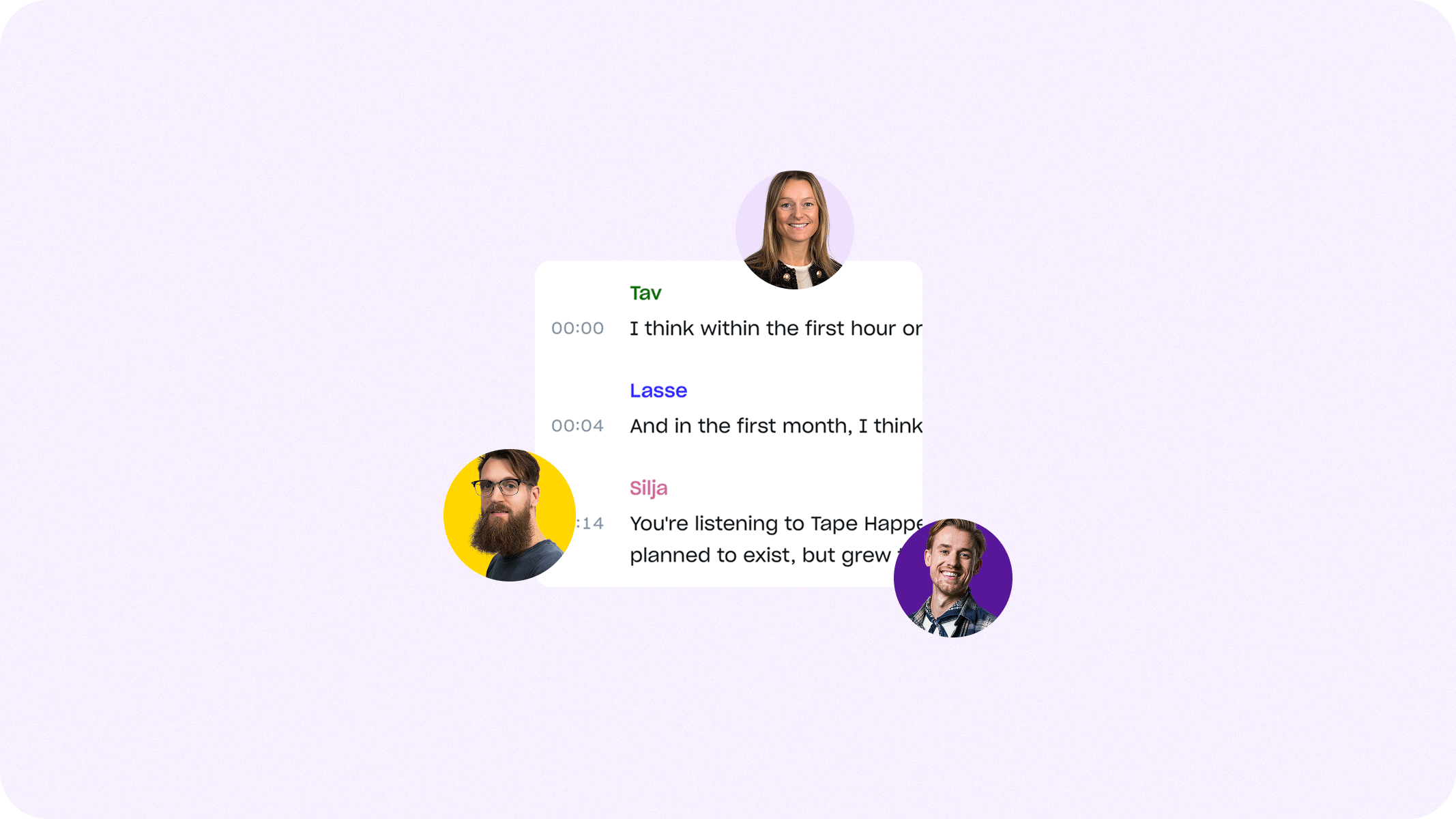
Make sure your transcript follows a uniform structure. This includes clear timestamps, speaker labels, and paragraph breaks whenever a new subject or question is introduced. By following this process, you transform the organic flow of a spoken conversation into a professional academic document.
How to format an interview transcript in apa format
To guarantee that your work follows the rules set out by the Publication Manual of the American Psychological Association, writing an interview transcript in apa style requires a specific approach. When transcribing an interview in apa format, follow these essential steps.
Header information and speaker identification
Begin with a title that accurately summarizes the topic. Include identifying details such as the date and the names of the participants. Throughout the text, you must clearly distinguish between the researcher and the participant. Use labels like “Interviewer:” and “Respondent:” before every line of dialogue.
Exact transcription and non-verbal notation
In an apa format interview transcript, you should enter words exactly as they were spoken. Incorporate utterances like “um” and “uh” unless they truly hinder comprehension. Indicate non-verbal cues in parentheses or brackets, such as [pauses] or [laughs], to provide background information for the discussion.
Paragraph structure and citations
Start a new paragraph whenever the speaker or the topic changes. This aids in the logical organization of the text and makes it easier for readers to navigate your data. When you are ready to include these findings in your paper, ensure you use the proper apa format for interview transcript citations within the body of your text.
Why dissertation transcription services are essential
A recent hypothetical case of a PhD candidate illustrates why transcript quality matters. The researcher conducted dozens of interviews regarding urban expansion. Rather than listening to recordings on a loop, they utilized automated thesis transcription to speed up the work.
Using a service like Good Tape ensures that your data remains protected throughout the process. Because the platform is fully GDPR compliant, you have peace of mind that sensitive research data is secure. The use of direct excerpts from a clean apa format transcript of interview gave the study a stronger voice and more genuine results.
What do interview transcripts look like in a final thesis?
In a finished dissertation, the format for interview transcript pages usually appears in the appendices. They are characterized by wide margins, double spacing, and numbered lines to allow for easy referencing during the defense or peer review.
The procedure of following apa criteria may feel overwhelming, but using a specialized transcription service allows you to transcribe your interview audio according to these standards in no time. Investing in a professional tool ensures that your interview transcript for dissertation is exactly as it should be, capturing every word and subtle emotion.
Conclusion: Elevating your qualitative analysis
Mastering how to write an interview transcript and applying the correct apa interview format example is about more than just checking a box. It is about respecting your data and your participants. By moving away from manual typing and embracing automated tools, you can spend more time analyzing your results and improving the overall quality of your academic work.

Trusted by professionals and teams








Want to read more?
Check out these related resources

Help center (FAQ)
What is an interview transcript for a dissertation?
It’s a written record of your recorded interviews, capturing every word, pause, and emotion. These transcripts form the backbone of your qualitative analysis and make your dissertation more structured and verifiable.
Do I need to include interview transcripts in my dissertation?
Yes. Especially for qualitative research. Including them gives transparency to your findings and helps readers trace how you drew your conclusions.
Should I transcribe interviews verbatim or clean them up?
Most dissertations require verbatim transcription — meaning every word, pause, and filler is included. However, for readability, a clean verbatim version may be acceptable depending on your university’s guidelines.
Is Good Tape free to use?
Yes. Good Tape offers a free plan so anyone can start transcribing without a credit card. Test in and upgrade to Pro later.
Why should I use Good Tape?
It’s built for accuracy, speed, and simplicity. Helping you focus on storytelling instead of manual transcription.
Is Good Tape secure?
Yes. Good Tape provides secure and accurate transcriptions that you can rely on. We are fully GDPR compliant and ISO27001 certified. We will never train on your data. Your data is yours and you remain in control.
Can I use AI transcription tools like Good Tape for my dissertation?
Absolutely. Good Tape provides fast, accurate, and secure transcription. Ideal for academic work. It saves you hours of manual work while maintaining GDPR compliance.
Secure transcription for interviews
Discover reliable audio and video transcription